


8 Tips To Build Resilience After Crisis
Our country has experienced so many unspeakable tragedies as of late. In May, several Americans were gunned down by a white supremacist while grocery shopping in Buffalo, and just ten days later, the lives of nineteen children and two teachers were taken in a Uvalde elementary school classroom. Understandably, we have been shaken. Men and women of color are on high alert just existing in their communities. Families are scared to send their children to school. Our nation mourns the loss of lives as well as the loss of a felt sense of safety and even a sense of hope.
While the nation surges with differing opinions on how to protect our communities, our neighborhoods, our schools, and our lives, it is important to focus on protecting our mental health. In times like these, it is easy to become overwhelmed with a sense of helplessness, hopelessness, and despair.

While these feelings are completely normal, feelings are meant to be felt and moved through so that they can naturally resolve. When we are unable to process through our emotions, they get stuck; they become toxic and can lead to dysfunctional behaviors, beliefs, and thoughts.
What is Resilience and Why is it Important?
Resilience is our ability to bounce back from adversity. When life hands us lemons, resilience is 'making lemonade.' We face difficulties every day like illnesses, financial hardships, breakups, abuse, and terrorist attacks. Being resilient means that we have the physical, mental, and emotional toughness to cope with and work through hardships. It doesn't mean that we aren't affected by these hard times and that we have stress-free lives.
To understand why resilience is important, let's think about what would happen without it. Imagine being unable to move through life's peaks and valleys. Without strengths and skills to pull from, you'd only be able to exist in the deepest parts of the valleys with no way out.

As our country experiences crisis after crisis, resilience is an important trait to have. It's not a trait that we have or we don't have; it's like a muscle. We have to continuously build upon our resilience muscles which we do all the time as we overcome day-to-day pressures.
Here are eight ways you can protect your emotional well-being, and strengthen your resilience.
Resilience After Crisis Tip #1: Adjust Your Thoughts
After a hate crime or a mass shooting, our thoughts can understandably become distorted by the traumatic event. A cognitive distortion is a thought that feels true and might even have some truth to it, but isn't the whole truth or isn't helpful. For example, after watching news coverage of yet another tragedy, it might be easy to think, 'Nowhere is safe.' Though this thought is true, it's not quite accurate, and it's definitely not helpful.
If a thought isn't true and helpful, adjust it. 'Nowhere is safe' can shift to, 'I will take necessary precautions.' Not only is the adjusted thought less alarming, but it also paves the way for action to be taken.
Resilience After Crisis Tip #2: Focus On What You CAN Control
There are things in every single situation that we can control and things we can't. The Circle of Control can help us categorize what we can control, what we can only influence, and what we have no control over.
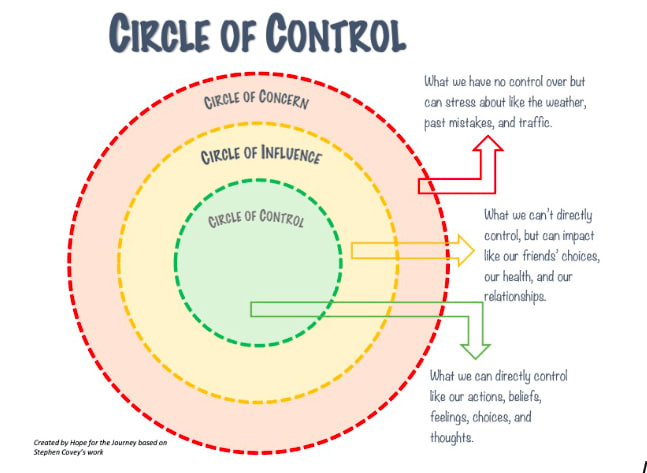
The innermost circle is what we can control. These are things like our attitudes, mindsets, beliefs, actions, reactions, choices, words, ideas, and thoughts.
The middle circle is what we can influence but not completely control. These are things like other people's thoughts, feelings, opinions, choices, actions, and ideas.
Resilience After Crisis Tip #3: Turn Off the News
Did you know that the average lifespan of an emotion is only 90 seconds? Emotions will swell up and naturally resolve unless we interrupt that process and stir the emotion back up. Reading or watching the news, talking with our friends and family, and ruminating about a traumatic event serve as a restart button in our brains that fuel our emotions.
Resilience After Crisis Tip #4: Connect
When we're stuck in our feelings after a catastrophe it's easy to isolate and cut ourselves off from the people and things in our lives that bring us joy.
Resilience After Crises Tip #5: Accept Your Feelings
Hurt people hurt people, and right now, we're all hurting. If we want less violence and hatred in the world, we have to start with our own grim feelings.
Resilience After Crises Tip #6: Self-care, Self-care, and SELF-CARE
We've all heard the importance of putting time and care into ourselves and our well-being, and it's a huge factor in being resilient.

Resilience After Crises Tip #7: Be Patient With Yourself
Everyone handles crises differently and on their own timeline. There are no rules for how we respond to tough situations or how long it takes to 'get over it.'
Resilience After Crises Tip #8: Seek Help
Building up our overall resilience might require some outside help.
- Thoughts of suicide or of not wanting to go on
- Marked changes in your mood
- Uncontrollable worry
- Feelings of hopelessness
- Disconnection
- Sleep difficulties
- Changes in your appetite
- Any other significant shift in your ability to handle your daily responsibilities
Taking Action
Adjusting our distorted thoughts, focusing on what we can control, turning off the news, connecting with our support systems, accepting our feelings, taking care of ourselves, being patient with ourselves, and seeking help when necessary are all ways that we can become more resilient.
Develop Your Resilience in Round Rock, TX or Austin, TX
Building your resilience and learning to overcome life's nonsense is much easier said than done. Our team of caring therapists would be honored to support you in learning the skills to help you better cope with the issues you face.
To start therapy with Hope For the Journey, please follow these simple steps:
- Contact Hope for the Journey
- Meet with a caring therapist
- Start receiving the support you and your teen deserve.
Other Services Offered At Hope For The Journey
Depression treatment isn't the only service we offer. Our team is happy to offer a number of services from our Round Rock and Austin therapy offices. Mental health services include therapy for anxiety and depression, domestic violence, sexual assault, PTSD, and EMDR. Our team also provides support for family members of all ages with counseling for teens and young adults, children and tweens, couples, men, and parents/partners.