

Depression treatment · Teens & adults
NW Austin · Round Rock · Online across Texas
Steadier days. Softer evenings. More of you to give where it matters.
Depression treatment that understands trauma — in Austin, Round Rock, and online across Texas. Not a pep talk. Care that actually helps.
Get Help Now
or call 512-400-4790
When your low mood won't lift
You've been pushing through for weeks — maybe months.
Getting out of bed feels heavy. Small tasks drain you. Patience runs short with the people you love, and guilt shows up right behind it. Food, sleep, energy, motivation to connect — everything's out of rhythm.
You're not looking for a pep talk. You want care that actually helps — because how you feel touches your family, your work, and your community every single day.

Why it can feel so heavy
What looks like “low motivation” is often a nervous system doing what it learned: conserve energy, shut down, expect less.
After trauma, your body can default to that protective mode far beyond the original danger.
It's not weakness. It's a survival strategy.
With the right support, your system can learn a steadier baseline — and mood, focus, and connection follow.
Why we're different
Three reasons clients choose us.
This isn't side work for us. Trauma is the core of what we do.

True trauma specialists
Every clinician is trained in trauma-focused approaches including EMDR and deeply experienced with complex trauma, dissociation, and sexual trauma. If you've felt “too complicated” before, you won't hear that here.

Creative, personalized care
Weekly sessions or focused bursts of work with an EMDR intensive — in office, at home, or online. A real person helps you find your best-fit therapist.

Real change that changes everything
Low mood touches every room you enter. We unwind stuck patterns so you think more clearly, feel more present, and show up the way you mean to.
What sessions look like
Relief first. Then the roots.
What the work looks like, at your pace:
1
Relief first
Sleep sorted and a relief plan for the hardest parts of your day. You'll track where your energy shows up — that's how you'll know it's working.
2
Understand yourself
Explore how you tick, your triggers, and how you got here.
3
Deeper phase
When you're ready, EMDR — weekly or intensive — and a plan built on what's working.
4
Integration
Routines, communication, and relationships rebuilt around the new way you feel about yourself.
5
After sexual assault
Choice and consent, always. EMDR for root-level relief; attachment work so trust becomes possible again.
6
What begins to change
Getting up feels manageable. Your tone softens. Focus returns. You feel present — and proud of how you're showing up.
You deserve a life worth living.
You shouldn't spend another day feeling alone in this.
Our proven process
Feel, heal, thrive.
Starting therapy is hard. So first, we help you settle your nervous system and find your motivation.
1
Feel
Quick, real-world skills that reduce fog and shutdown — breath that helps, motivation habits, sleep routines that hold.
2
Heal
When steady enough, process what's driving the depression with EMDR, parts work, and attachment-focused work, at your pace.
3
Thrive
Apply what you now believe about yourself — that you're worthy and meant to be here — to your relationships, decisions, and patterns. Then make it last.
Depression & EMDR questions
What people ask before they call.
Anything we haven't answered? Call 512-400-4790 — you'll talk to Nia, not a phone tree.
Many clients feel better with therapy alone; others benefit from a combined plan. We coordinate with prescribers when that serves your goals. You stay in charge of your choices.
You're not a lost cause. Pacing, approach, and fit matter. Trauma-informed, nervous-system-based care often unlocks movement where past attempts stalled — and usually more gently. We go slow to go fast.
Most people see early shifts within a few weeks — sleep, energy, getting through the day. Deeper relief grows as we address roots with EMDR. The pace depends on how much trauma, neglect, or betrayal you've carried.
No. We start with safety and skills. EMDR doesn't require graphic detail to work — we follow your pace.
Eye Movement Desensitization and Reprocessing is an eight-phase, research-backed therapy that helps your brain file painful experiences so they stop popping up uninvited. Simple traumas can resolve in a few sessions; complex histories take longer. It's powerful, and it isn't magic — your therapist tailors it to you.
No. You're in full control the whole time — we'll even teach you how to signal us to stop.
You won't white-knuckle through your worst memories. Before any memory work you learn to shift into calm fast and build “resources” to turn the intensity down. That preparation phase can be long if your history is complex — and it's the part most therapists skip.
We're self-pay and provide superbills for out-of-network reimbursement. Our nonprofit sliding scale is on the Rates page.

Your first call is with a real person.
Nia, our Client Care Coordinator, will listen to what's going on and match you with the right therapist. No phone tree, no pressure.
Get Help Now
or call 512-400-4790
Meet the team
People who meet depth with skill.
Every clinician is EMDR-trained and works with the trauma underneath depression. Nia will match you with the right fit on your first call.

Heather Hammock LMFT
EMDR Certified
Round Rock & online
Adults & couples
Intensives only

Maegan Woytek LPC
EMDR Certified
Online across Texas
Adults & teens
Weekly sessions

Shauna Onabajo LPC
EMDR trained
Austin & online
Adults & teens
Weekly or intensives

Oliver Papa-Garcia LPC
EMDR trained
Round Rock & online
Adults & teens
Weekly sessions

Bailey Pellissier LMSW
EMDR trained
Austin & online
Adults & teens
Weekly sessions

Lily Nguyen LPC-Associate
Neurodivergence-affirming
Round Rock & online
Adults & couples
Weekly sessions

Ivana Crumpton LPC-Associate
Austin & online
Kids, teens & adults
Starting October

Traci W. Pirri LCSW-S
EMDR Consultant
Austin & online
Adults & teens
Intensives only
Resident-level clinicians are supervised weekly by a senior trauma specialist — more eyes on your care, not fewer.
Two ways to work
Weekly therapy, or a few focused days.
Both get to the same place. The difference is pace — and which one fits your life right now.
Most people start here
Weekly therapy
About an hour, once a week
- 50-minute sessions, usually once a week
- Steady, paced work: safety and skills first, then the deeper work
- Shauna, Oliver, Maegan, Bailey, and Lily — and Ivana from October
Same work, compressed
EMDR intensive
Half or full days, back to back
- Half or full days across one to five days
- In our office, in your home, online, or at a retreat location of your choice
- For people ready to go deeper — or who can't wait months
- With Heather Hammock, Shauna Onabajo, or Traci Pirri
Our money-back guarantee applies to weekly and pre-intensive sessions, not to the intensive itself. We'll explain how that works before you book.
Why people trust us
501(c)(3) nonprofit

Money-back guarantee
Not satisfied? We'll refund up to your first two sessions. Excludes intensives.
Advanced therapies
EMDR-trained team with weekly complex-trauma consultation.
Compassionate care
Warm, practical, paced to what you can handle.
“
Hope For The Journey is one of the most solid teams of mental health professionals that I've had the pleasure of interacting with. They put so much time and effort into being well trained, curious, compassionate, and driven towards providing individuals with the best care possible.
Joshua Adair, LCSW · Referring therapist
Sliding-scale spotsStandard rate
We're a nonprofit, so cost shouldn't be the reason you wait. Sliding-scale spots with licensed clinicians and supervised residents are part of how we work.
Where we meet
Two offices, or anywhere in Texas.
Easy to reach from Northwest Austin, Cedar Park, and Georgetown — or meet online from home if that feels safer. Call 512-400-4790 and Nia will help you pick.
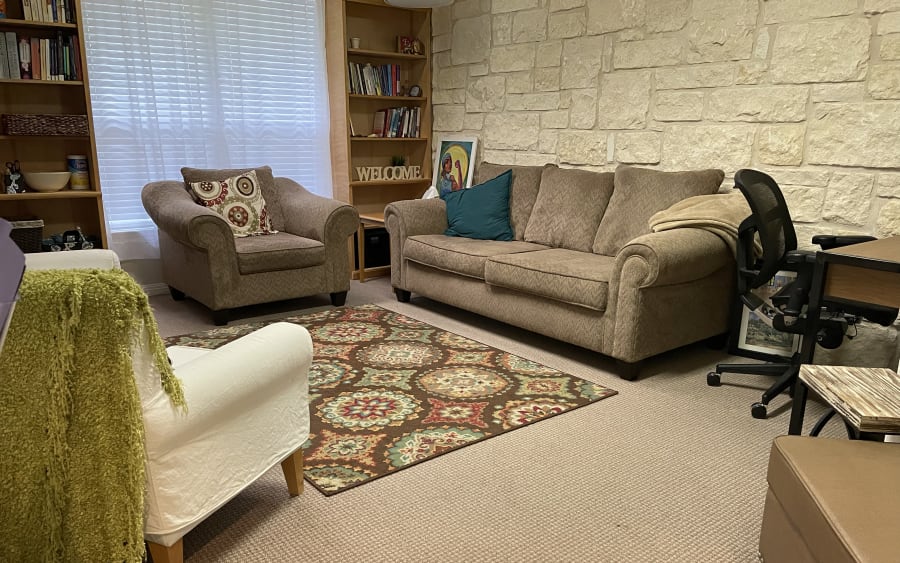
NW Austin
4131 Spicewood Springs Rd. Ste. L-1
Austin, TX 78759
Austin, TX 78759
In person · all ages

Round Rock
1101 Satellite View #501
Round Rock, TX 78665
Round Rock, TX 78665
In person · all ages
Online across Texas
Secure video sessions from home
Every therapist offers online
Start a different chapter.
Match with a therapist who specializes in trauma-related mood symptoms. We'll build a practical plan that fits your life — and supports the people who count on you.
Get Help Now
or call 512-400-4790