
EMDR therapy · Kids, teens & adults
NW Austin · Round Rock · Online across Texas
EMDR Therapy in Austin, Texas
EMDR helps your brain file the experiences that keep you scared, angry, or stuck — so you can make real, lasting change. True trauma specialists, 70+ combined years of experience.
Get Help Now
or call 512-400-4790
Why EMDR
EMDR helps your brain get unstuck
If you've been in therapy for years and nothing has really changed, EMDR might be just the thing.
EMDR has a variety of uses and is safe with kids, adults, parents, and partners. It is a powerful tool that works differently.

What EMDR helps with
PTSD and trauma
Anxiety and panic
Depression
Relationship patterns
Thoughts of hurting yourself
Grief
Who it's for
EMDR for every age
Play and creativity make it work for kids. Focus and pace make it work for busy adults. Specialized training makes it work for couples and families.

Individuals
Fast, effective help — even if you've tried therapy many times. Working with a specialist trained in dissociation and complex trauma is just… different.

Couples & families
Sometimes you heal as a group. EMDR gives our family and couples work the extra boost to make a real shift.

Kids, tweens & teens
EMDR combined with play, sandtray, and art — engaging sessions kids actually want to attend.

EMDR intensives
Half day, full day, or several days: the benefit of months of weekly sessions in a fraction of the time.
What changes
Real change that changes everything.
The end of EMDR looks like this:
01
The memory loses its charge
It's still yours, but it feels farther away and less important.
02
Your body believes you're safe
Fewer alarms, better sleep, a calmer baseline.
03
You believe something new about yourself
“I'm okay.” “I matter.” And you can see it in how you react.
04
Relationships get easier
Old hurts stop getting between you and the people you love.
05
Patterns shift
The reactions you couldn't explain start to make sense — and change.
06
You know when you're done
Unlike therapies that go on for years, EMDR ends when the work is done.
EMDR isn't endless therapy. It has a beginning and an end.
Simple and fast, or complicated and slow — either way, our EMDR therapists have you covered.
The three stages
Feel, heal, thrive.
Your pace, not ours.
1
Feel
Learn to notice and tolerate your emotions and shift into calm fast. This is what makes the deeper work safe — and what most therapists skip.
2
Heal
Dig into what's driving the bus. Take the negative charge out of the memories that shape your pain.
3
Thrive
Put it together in real life — your reactions, your relationships, your body. This is where you celebrate how far you've come.
Common questions
Curious about EMDR, and a little nervous?
Anything we haven't answered? Call 512-400-4790 — you'll talk to Nia, not a phone tree.
Eye Movement Desensitization and Reprocessing is an eight-phase, research-backed therapy that helps your brain file painful experiences so they stop popping up uninvited. Simple traumas can resolve in a few sessions; complex histories take longer. It's powerful, and it isn't magic — your therapist tailors it to you.
No. You're in full control the whole time — we'll even teach you how to signal us to stop.
You won't white-knuckle through your worst memories. Before any memory work you learn to shift into calm fast and build “resources” to turn the intensity down. That preparation phase can be long if your history is complex — and it's the part most therapists skip.
All therapy leans into things that are uncomfortable. But if we're doing our job, you'll have the skills and confidence to tolerate the emotions before we dive into the deep stuff.
Eye movements, tapping, or alternating tones. For kids it might look like patty-cake or coloring back and forth. Online, your therapist will guide you to tap on your legs or shoulders, or use a program that runs the eye movements.
Yes. Every therapist on this page offers secure telehealth across Texas, and BLS adapts well to video sessions.
No. We start with safety and skills. EMDR doesn't require graphic detail to work — we follow your pace.
Most people start weekly, then space sessions out as they get closer to finishing. You and your therapist decide together in the first session.
EMDR has a distinct beginning and end. You're done when you truly believe something positive about yourself — and you can see it in your reactions, your relationships, and your relaxed body.
We're self-pay and provide superbills for out-of-network reimbursement. Our nonprofit sliding scale is on the Rates page.

Your first call is with a real person.
Nia, our Client Care Coordinator, will listen to what's going on and match you with the right therapist. No phone tree, no pressure.
Get Help Now
or call 512-400-4790
Meet the EMDR team
Trained, consulted, and certified.
Every therapist here receives regular EMDR consultation — basic training, certification, a weekly complex-trauma consultation group, and consultant training at the top. Nia will match you on your first call.

Heather Hammock LMFT
EMDR Certified
Round Rock & online
Adults & couples
Intensives only

Maegan Woytek LPC
EMDR Certified
Online across Texas
Adults & teens
Weekly sessions

Shauna Onabajo LPC
EMDR trained
Austin & online
Adults & teens
Weekly or intensives

Oliver Papa-Garcia LPC
EMDR trained
Round Rock & online
Adults & teens
Weekly sessions

Bailey Pellissier LMSW
EMDR trained
Austin & online
Adults & teens
Weekly sessions

Lily Nguyen LPC-Associate
Neurodivergence-affirming
Round Rock & online
Adults & couples
Weekly sessions

Ivana Crumpton LPC-Associate
Austin & online
Kids, teens & adults
Starting October

Traci W. Pirri LCSW-S
EMDR Consultant
Austin & online
Adults & teens
Intensives only
Resident-level clinicians are supervised weekly by a senior trauma specialist — more eyes on your care, not fewer.
Two ways to work
Weekly therapy, or a few focused days.
Both get to the same place. The difference is pace — and which one fits your life right now.
Most people start here
Weekly therapy
About an hour, once a week
- 50-minute sessions, usually once a week
- Steady, paced work: safety and skills first, then the deeper work
- Shauna, Oliver, Maegan, Bailey, and Lily — and Ivana from October
Same work, compressed
EMDR intensive
Half or full days, back to back
- Half or full days across one to five days
- In our office, in your home, online, or at a retreat location of your choice
- For people ready to go deeper — or who can't wait months
- With Heather Hammock, Shauna Onabajo, or Traci Pirri
Our money-back guarantee applies to weekly and pre-intensive sessions, not to the intensive itself. We'll explain how that works before you book.
Why people trust us
501(c)(3) nonprofit

Money-back guarantee
Not satisfied? We'll refund up to your first two sessions. Excludes intensives.
Advanced therapies
EMDR-trained team with weekly complex-trauma consultation.
Compassionate care
Warm, practical, paced to what you can handle.
“
I've had an amazing experience using EMDR therapy to address my childhood trauma. It's incredible how something so simple like eye movements can make such a huge difference on how I feel about my most challenging memories! I highly recommend reaching out if you're looking for trauma or PTSD therapy in Austin.
Chris M.
Sliding-scale spotsStandard rate
We're a nonprofit, so cost shouldn't be the reason you wait. Sliding-scale spots with licensed clinicians and supervised residents are part of how we work.
Where we meet
Two offices, or anywhere in Texas.
Easy to reach from Northwest Austin, Cedar Park, and Georgetown — or meet online from home if that feels safer. Call 512-400-4790 and Nia will help you pick.
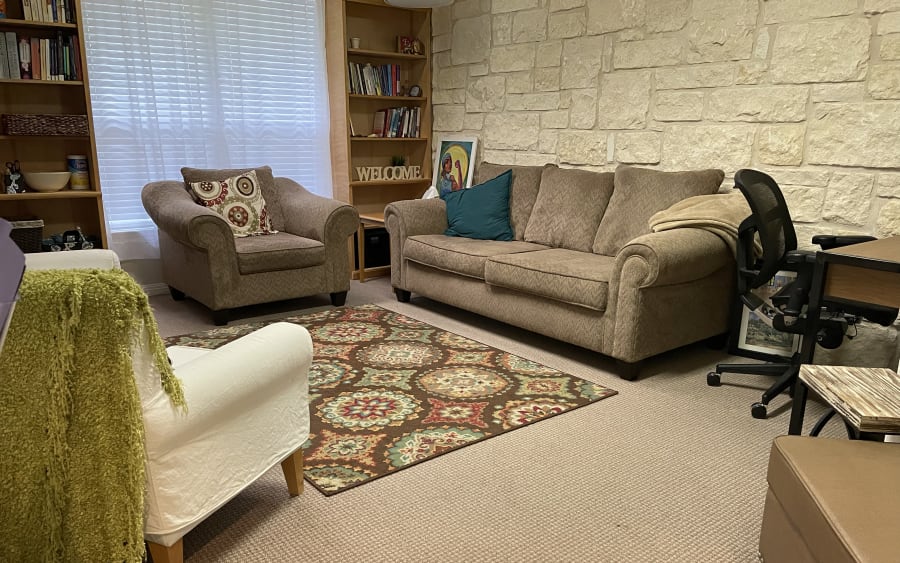
NW Austin
4131 Spicewood Springs Rd. Ste. L-1
Austin, TX 78759
Austin, TX 78759
In person · all ages

Round Rock
1101 Satellite View #501
Round Rock, TX 78665
Round Rock, TX 78665
In person · all ages
Online across Texas
Secure video sessions from home
Every therapist offers online
You don't have to carry this alone. Let's get your healing started.
Schedule a consult call. We'll help you find the right therapist and build a plan that fits your life.
Get Help Now
or call 512-400-4790